Sister-in-law act
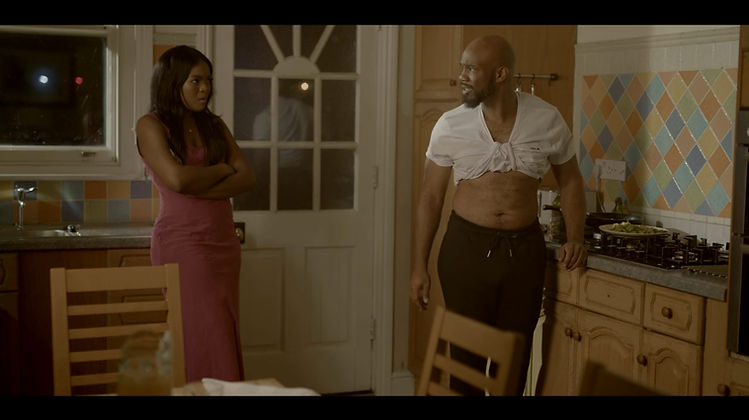
Life couldn't get any better for Tabitha. Perfect job, perfect home, well-behaved husband...and now, the lead singer in her church choir.
That is until her sister-in-law, whom she didn't even know existed, knocks at her door. Then things take a turn for the worse, at least for Tabitha, and nobody seems to notice. Which makes her think maybe her sister-in-law isn't who she says she is and has cynical intentions.
Statment
After my success with the production of "Fighting for Love", I was offered "Sister-in-law act". The genre was family comedy, a whole new area for me. After reading the script, I understood the writer's intentions with the story's comedic effects. I'd aim to respectfully reshape into my own seminal dialect in order for it to feel more natural. This was, of course, a discussion that needed to be had with the producer, who was willing to grant me more creative liberty after "Fighting for Love".
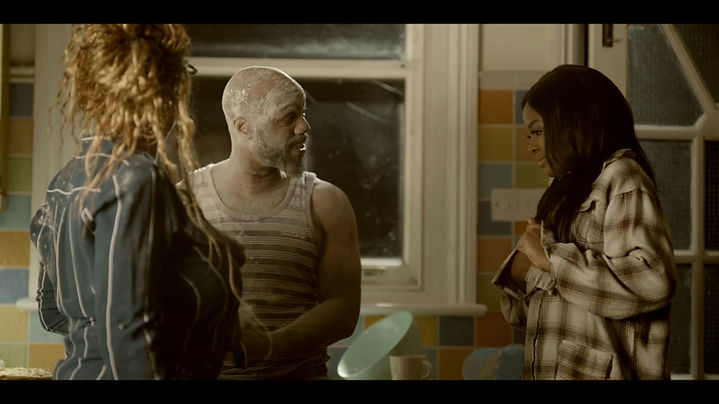
Later, the dialogues and comedic punchlines had to be discussed with the actors, as it is their delivery style that decides whether the jokes would land or not. After going through the reading with the actors, we discussed the comedic effects of the dialogues and how we would approach them. Some would work, but there would be scenarios, as is in the spirit of the moment, which I had learned with the entirety of the production of my short film "Bubbles", that whilst on set, through intense focus, you should trust your instincts and allow the creativity to burst. With such an approach, the comedy would not be premeditated; it would be fresh. This strategy always proves itself, at least in my experience, to be valuable. One should be able to trust their crew and cast after having a clear understanding of them, as such, you would figure your approach and recognise each member's strength.
We would come up with jokes and slightly alter the dialogue exchange without doing any perceptible alteration to the main direction of the script. The actors would enjoy this freedom and would be highly encouraged to experiment with different approaches. Which is important: to experiment with the resources that are handed to us and seek ways to better present them.
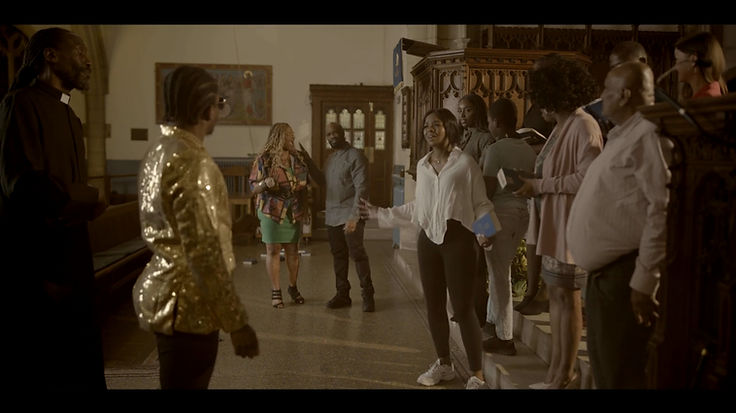
On the same matter of experimentation, there were the visual aspects of the story that I wanted to delve into. In my previous feature film, I experimented with long takes, where the camera would pan or tilt; with this new opportunity, I wanted to take it further. I liked to allow the shot to develop. This would exercise my choreography skills unlike before. One can acknowledge the framing skills of painters (one essential aspect of their work deals with framing) such as Edward Hopper or Edvard Munch, but these are frames within motion. We have to pick the correct location and understand what occurs in an entire scene and through positioning the camera, we allow it to develop and unfold and even bare witness to what is taking place in the background where the script does not mention the actions but as readers, we are already aware of them and what is taking place in the foreground.
For example: in one scene where we shot the choir, we see the sister-in-law interrupt the choir (in the foreground) by entering through a door, followed by Tabitha's husband. Tabitha takes her husband away to argue with him and the sister-in-law reaches the choir singers in the foreground. By specially positioning the actors in the foreground, we would be able to see Tabitha argue with her husband in the background through the gap between the sister-in-law and the choir singers. Later, Tabitha would approach the foreground and fill up the gap in order to have a conversation with the group in the foreground.
Experiments such as these would encapsulate the shot to be entertaining for much longer, as action is constantly taking place in a fastidious manner, where the events of the scene are unfolding right before our eyes.
Through developing shots with careful choreography as well as relying on the tension of the moment with the actors so to exert the raw comedic essence, we were all able to create in a form that we had never done and feel the satisfaction when we saw our results. At this moment, as I'm writing this statement, I have had the fortune of directing 3 feature films. This remains the most thrilling experience I have achieved so far.