Freak Off
An obscure singer with dreams of making it in the music industry finally gets her chance when she is recognised by a music mogul.
She achieves her easy entry, though soon after, strange events occur which make her question her position with the inner circle and the fate of the mogul's previous stars. She realises that leaving is more difficult than she thought.

Statment
My latest feature film directorial experience took place in January 2025. After the success of the last two feature films, the executive producers and film producers were happy to present another offer.
The subject of this thriller was about the cynical actions taking place behind the curtains in the music industry. It plays with themes of isolation, greed and dissonance.
We have our main character, Mia, who is an inspiring singer working minimum wage at a coffee shop. Her luck takes a turn when she is discovered by a famous singer's manager. Soon, her life drastically changes as she is now partially famous and has started a contract with the music mogul's production company. Amidst nights of heavy booze and drugs, mysterious events occur that make her question her employer's intentions: people missing, loss of memory from nights prior and uncomfortable recording sessions.
A considerable aspect of the story, aside from the actions, would be the character's internal feelings. I wanted to play with resources at our position in order to uniquely convey those emotions. Previously, I had experimented with a variety of techniques to convey different emotions, such as: Framing, developing shots, indirect, subtle dialogues and radically different character dynamics in order to express what I would like to in a subliminal manner for a subtext. Yet I hadn't had the opportunity to experiment as much as I wanted to with colours.
Colours are essential for creating characteristics or vibes within the frame. Aside from inspirations from films, we can again refer to paintings. You can look at modern art or the Sistine Chapel, you can trace from Caravaggio to Van Gogh to Turner, Kokoschka and Hopper, colours are essential; they convey deep emotions which the painter cannot verbally express. We can even bring it down to the basics of abstract art and talk for hours about the work of Mark Rothko, who uses mixtures of colour to convey rich emotions.
Which is why, for this film, I wanted to take inspiration from Mark Rothko.
Since we had budgetary constraints, we couldn't invest as much in props or set design, though, since this story is about the music industry, we could rely on the RGB lights. It would allow the logistics to function with our desired intentions.
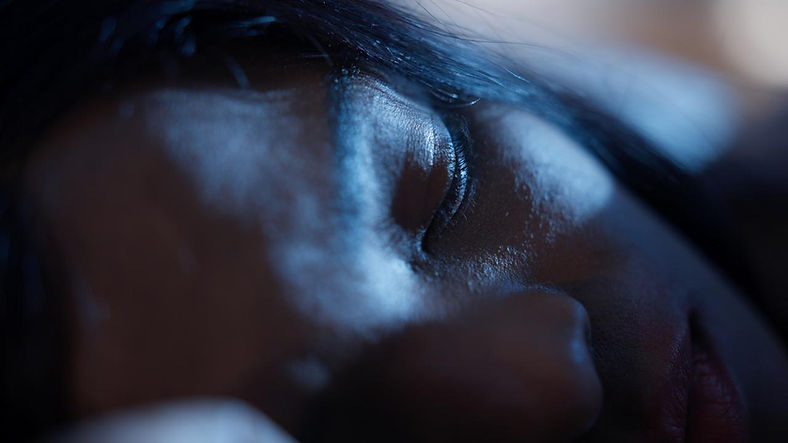
For example: There were scenes where our main character, Mia, was in a covert, dangerous environment without knowing it herself. When it came to lighting, I brought it to the DOP's attention that we should have a mellow, relaxing blue light as our main and add a small batch of red light on the side. Red would signify alert or danger. That would be one use of colour to imply subtextual meaning.
Another example of lighting which we used was when the detectives questioned the two music moguls. The main colours which we used in this scene were again red and blue. Not only do we choreograph the detectives to sit on the side of blue light (hinting at honesty and tutelage) and the mogules on the side of red (hinting at villainous cynicism), but also red and blue are the common colours associated with the police.
Another visual approach which we had was the use of tight lenses. We wanted the images to feel compressed, almost suffocating. In order to create this feeling for the audience, which resonates with the main character throughout the entire story.
These were the experiments we aimed to focus on and were successful in achieving them.